Tag: Jazz Composers Alliance Orchestra
-

A Wallflower In The Amazon
Darrell Katz’ compositions unfold like suspense films, pregnant with anticipation, marked by unexpected twists and turns and exotic panoramas, packed with glorious collisions, barely skirted disasters and triumphant comings-together. (more…)
-
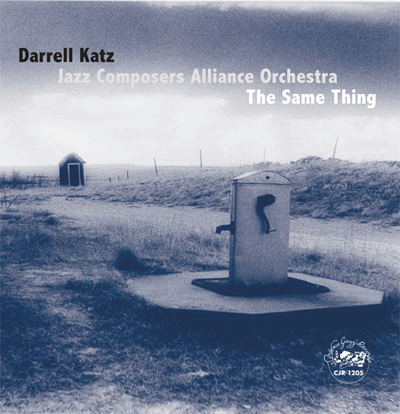
The Same Thing
- December 30, 1994
- Everybody Loves Ray Charles
- I’m Me and You’re Not Ha Ha
- Like A Wind
- The Same Thing
- Lemmings
-
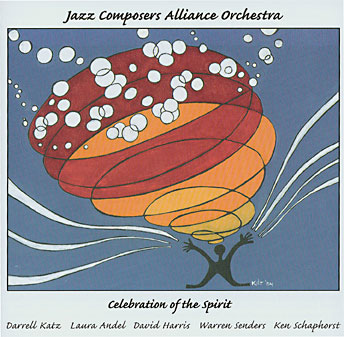
Celebration Of The Spirit
The Jazz Composers Alliance Orchestra was established by Darrell Katz and Ken Schaphorst in 1985 as a collective and presenting orchestra. The Orchestra is the resident ensemble of the Jazz Composers Alliance. Over the years, it has managed overall to bring a satisfying balance between original compositions and the improvising aesthetic. Historically, the few bands that have successfully specifically emphasized those two elements have not always managed (or managed for long) to keep a high standard on both. Ellington, Kenton, and Breuker are 3 bands that come to mind as having succeeded and grown old while often encompassing members with long tenures. And while the JCA Orchestra is still relatively young, less traveled, and less documented, when compared with the longevity of those bands, perhaps it would not be hyperbole to begin to consider it (along with the London Jazz Composers Orchestra) on a short list of bands that have successfully and consistently combined the two elements/disciplines of original composition and instant composition/improvisation.
Having worked with Darrell since the early 1990s and taking into account the overall quality of the Jazz Composers Alliance Orchestra’s body of work gave me the confidence to venture out of our usual confines and try to bring our efforts for excellence in artistry and audio to a whole new situation with its very different demands and difficulties.
We arrived at The Tsai Performance Center at Boston University a bit after 9:00 a.m. and my anxieties were soon lessened by the timely arrival, pleasantries, and welcome of all the participants. After three hours of setting up, warming up, and sound checks, we began the formal recording at about 12:30 p.m. Here we were on a beautifully crisp fall Sunday morning following a dramatic late night extra inning playoff victory by the Boston Red Sox. Baseball was in the Boston air and, with another do-or-die playoff game in the works for that afternoon, we would be ensconced in The Tsai trying to produce artistic excellence. While this baseball thing should not be given undue notice, it should be taken into account, as evidenced by Bob Pilkington, resplendent throughout the session in a Red Sox hat, and the occasional yawns from bandmembers recovering perhaps from too much BoSox ball the night before.
So there was joy in Beantown, the spirits were good, and the adrenaline high as the band opened up with Laura Andel’s Industrial Hearts and its dynamic crescendoing contrast between the pointillism of percussion and reeds set in the great organic birthing of the brass.
Laura also contributed Nodes, a fine piece showcasing the band and composition as soloist.
Darrell Katz’ Toscar was up next, a piece that sounds informed by Gil Evans and a post WWII modern aesthetic.
Ice Time preceded a lunch break, a hip piece punctuated by a rather fun use of percussion. During the break, Takaaki Masuko told me that, as regards percussion, “Nothing was written. I asked Darrell, ‘What do you want me to do?’ and he said, ‘Just play your things’.” Later, Darrell told me he meant for Takaaki to “invent what he did from the drum music (parts)” presented to him.
Ken Schaphorst was next to take his turn as conductor, opening with How to Say Goodbye, a lovely piece featuring an effective small group suspended within the larger group, slowly absorbing and assimilating one another into a unified and resolved whole.
David Harris’ Th-Outward is a composition built around notated music, visual clues in the form of written instructions (i.e., winds/bones or alto duets, etc.), and conduction. Remarkably coherent, it alone is proof of the structure inherent in so-called free music and a wonderful synthesis of the first 100 years of creative improvised music.
The final conductor/composer, Warren Senders, took over—after a brief break—to present his twopart suite Elegies and Recollections, a sobering round that works into one’s psyche before celebration and final reflection.
We finished up a bit after 8 p.m. after a pretty exhaustive day. Consider the following, when you’re listening to this wonderful music:
Composition: Music of the composers’ inspiration that must be played with precision, and interesting and rewarding enough to attract quality artists who must largely give of their time and talents to rehearse and execute.
Improvisation: In this situation an artist must, on a moment’s notice, be able to sit outside the group and its composed confines and project in a meaningful, inspired, and individual manner.
Recording: It’s a no-net circumstance. What you hear is what was played; real sequencing, real time, real dynamics. This is not a cut&paste edit job, not”the best parts” of various takes. There is no opportunity for an individual (or section) to pull back on any subsequent take(s) after a great statement or first take, thinking that it will be spliced and edited into the whole. There is no opportunity for any artist to trample over others thinking that the engineer will impose the “correct dynamic” and fix it in the mix.
These people worked hard for almost 11 hours straight, executing 20 complete takes (all of them with some merit), with no place to hide. This is a document of a real artistic experience. But all that would be of smallnote were it not a wonderful and rewarding concert experience, which this is.
It’s easy to get discouraged in this business, but working with this group—these 21 individuals—is the kind of endorphin that combats discouragement. For the artists, this producer, and now you, the listener, this isa reaffirming celebration of the bright spirits.
Robert D. Rusch – October 5&6, 2003
- Tracks:
- How to Say Goodbye
- Elegies
- And Recollections
- Ice Time
- Toscar
- Industrial Hearts
- Nodes
- Th-outward
-

In, Thru, and Out
JAZZ COMPOSERS ALLIANCE ORCHESTRA SHINES ON IN, THRU, AND OUT
“Some of the most exciting writing around for the big jazz band.” – Steven Loewy, All Music Guide
In, Thru, and Out (Cadence Jazz), the fourth release by the Jazz Composers Alliance Orchestra, showcases new work by JCA resident composers Laura Andel, David Harris, Darrell Katz, and Warren Sanders. Recorded live in concert in 2001, the album features inspired versions of six compositions. Each piece is written in the composer’s distinctive voice, but all of the music reflects a shared commitment to exploring the potential of composing for improvisers and expanding the jazz big band vocabulary.
This shared vision binds these works together, despite the extraordinarily wide stylistic range they cover. The title track, by trombonist-composer David Harris, integrates free improvisation, graphic scores, and conventional notation into a single piece. Harris’ other contribution “Testify,” offers a startling contrast-a hard swinging, Hammond B3-powered homage to the gospel music tradition. Laura Andel also offers two contrasting pieces. “El Tiempo” plays with the listener’s sense of time as a haunting melody floats over different tempos and is subjected to a variety of orchestrations. The buoyant “Caruaru” weaves together a bubbling Brazilian folk theme with original material that takes the folk elements in new directions. Darrell Katz’s four-part “Hemphill” is a reworking of a saxophone quartet piece that plays with jazz big band conventions as it pays tribute to the late saxophonist-composer Julius Hemphill. Katz incorporates rich melodic invention, call and response, the blues, and other jazz elements into an extended form that includes a setting of a poem by Paula Tatarunis. In “Bats,” Warren Senders sinuous melodies fuse jazz with an international blend of African, Indian, and Indonesian elements. Senders also contributes “The Metric Dozens,” an ingenious take off on boogie- piano conventions that generates unpredictable interactions between soloists, horn sections, and rhythm section.
The orchestra draws on some of Boston’s most accomplished improvisers, several of whom are bandleaders in their own right. Not only do they create a unified and distinctive orchestral sound, but their ranks include first rate soloists. Katz’s “Hemphill” showcases a number of the band’s stellar soloists, including trumpeters Mike Peipman and Keiichi Hashimoto, trombonist Bob Pilkington, saxophonist Jeff Hudgins, guitarist Norm Zocher, and drummer Harvey Wirht. Composer-trombonist Harris solos with revival meeting fervor on “Testify.” On Andel’s “Caruaru,” alto saxophonist Jim Hobbs digs into the propulsive groove in his compelling and fiery improvisation. Tenor saxophonist Phil Scarff shows his versatility with an angular unsettling solo on “In, Thru, and Out,” and a gently melodious outing that flows with the Indian rhythms of “Bats.” Pianist Art Bailey has fun with his rollicking boogie-woogie variations on “The Metric Dozens.”
Since 1985, the Jazz Composers Alliance has supported and promoted composition in the jazz idiom in several ways. Through its resident ensemble, the JCA Orchestra, they have premiered more than 100 new works by JCA composers-in-residence and guest composers, including commissioned works from Muhal Richard Abrams, Marty Ehrlich, and Wayne Horvitz. Through the Signature Concert Series, they also have presented works by Sam Rivers, Julius Hemphill, Henry Threadgill, Dave Holland, and Steve Lacy, among many others. In addition to a regular concert schedule, since 1993 the JCA has administered the Julius Hemphill Composition Awards, an international competition that recognizes innovative work for both small and large ensembles. In 2001, the JCA instituted the Composers in the Classroom program, sending resident jazz composers into Boston-area elementary schools to help students develop and apply skills in composition and improvisation.
In, Thru, and Out proves that after nearly 20 years, the Jazz Composers Alliance is still one of the premiere showcases for exciting new music for large jazz ensembles.
-

The Death of Simone Weil
COMPOSER DARRELL KATZ EXCEPTIONAL CD THE DEATH OF SIMONE WEIL
Featuring The Jazz Composers Alliance Orchestra with Rebecca Shrimpton; Text by Paula Tatarunis
“Eerie and moving, and even swinging” – Jon Garelick, Boston Phoenix
Darrell Katz’s improvisational canata, The Death of Simone Weil (Innova), is among the most ambitious large-scale works for voice and jazz orchestra ever composed. Performed by Boston’s Jazz Composer’s Alliance Orchestra and singer Rebecca Shrimpton, Katz’s setting of poet Paula Tatarunis’ meditation on the life and death of philosopher Weil is remarkable for its lyrical clarity and power.
“There’s an impressive variety of textures, colors, and rhythm in all of the JCA’s collaborations, but it’s never attempted anything like Katz’s Simone Weil,” writes the Boston Phoenix’s Jon Garelick, who picked the album as one of the top 10 releases of 2003, “This work is eerie and moving, and even swinging.”
Katz’s melodic invention, his use of orchestral colors, harmony, and the underpinning of dance rhythms, all bring out nuances of meaning and feeling in the poem. “I was really into the idea of getting the melody, working with the text, and figuring out what to do with it,” Katz says. “I think the best model for what I wanted to do is the Tin Pan Alley composers. I wanted the words to line up with the melodies so it sounded very conversational. I wanted the text to be really clear and easy to understand.”
The music’s sensitivity to the sound and meaning of words manifests itself in ways both small and large. For instance, the light, bouncy sound of the words “Viana do Castelo” inspired the Latin rhythms in the opening moments of “Renault.” The blues that concludes that section of the six-part suite was suggested by the slavery imagery that links the Renault plant workers and the fishermen in the poem. The unity of words and music in the suite and the subtle shadings of thought and feeling it contains are beautifully captured by singer Rebecca Shrimpton. The soloists, including trombonist Bob Pilkington, guitarist Norm Zocher, and saxophonist Jeremy Udden, always work within the mood and structure of the piece, adding the immediacy of improvisation to work that is already deeply emotional.
Katz, a founder of Boston’s Jazz Composers Alliance and Orchestra, has synthesized a wide range of influences including modern classical, folk traditions, and the entire jazz legacy into a mature and personal compositional style. His work can be heard on previous JCA Orchestra releases-Flux, Dreamland, and In, Thru, and Out. His settings of the poetry of his wife Tatarunis, whose work has appeared in small presses such as Ploughshares and The Massachusetts Review, are found on the Jazz Composers Alliance Sax Quartet’s I’m Me and You’re Not (Brownstone, 1999) and the JCA Orchestra’s In, Thru, and Out (Cadence Jazz Records, 2003).
Since 1985, the Jazz Composers Alliance has supported and promoted composition in the jazz idiom in several ways. Through its resident ensemble, the JCA Orchestra, they’ve premiered more than 100 new works by JCA composers-in-residence and guest composers, including commissioned works from Muhal Richard Abrams, Marty Ehrlich, and Wayne Horvitz. Through the Signature Concert Series, they also have presented works by Sam Rivers, Julius Hemphill, Henry Threadgill, Dave Holland, and Steve Lacy, among many others. In addition to a regular concert schedule, since 1993 the JCA has administered the Julius Hemphill Composition Awards, an international competition that recognizes innovative work for both small and large ensembles. In 2001, the JCA instituted the Composers in the Classroom program, sending resident jazz composers into Boston-area elementary schools to help students develop and apply skills in composition and improvisation.
The Death of Simone Weil is a landmark recording for the Jazz Composer’s Allaince, JCA Orchestra, and composer Darrell Katz.


